
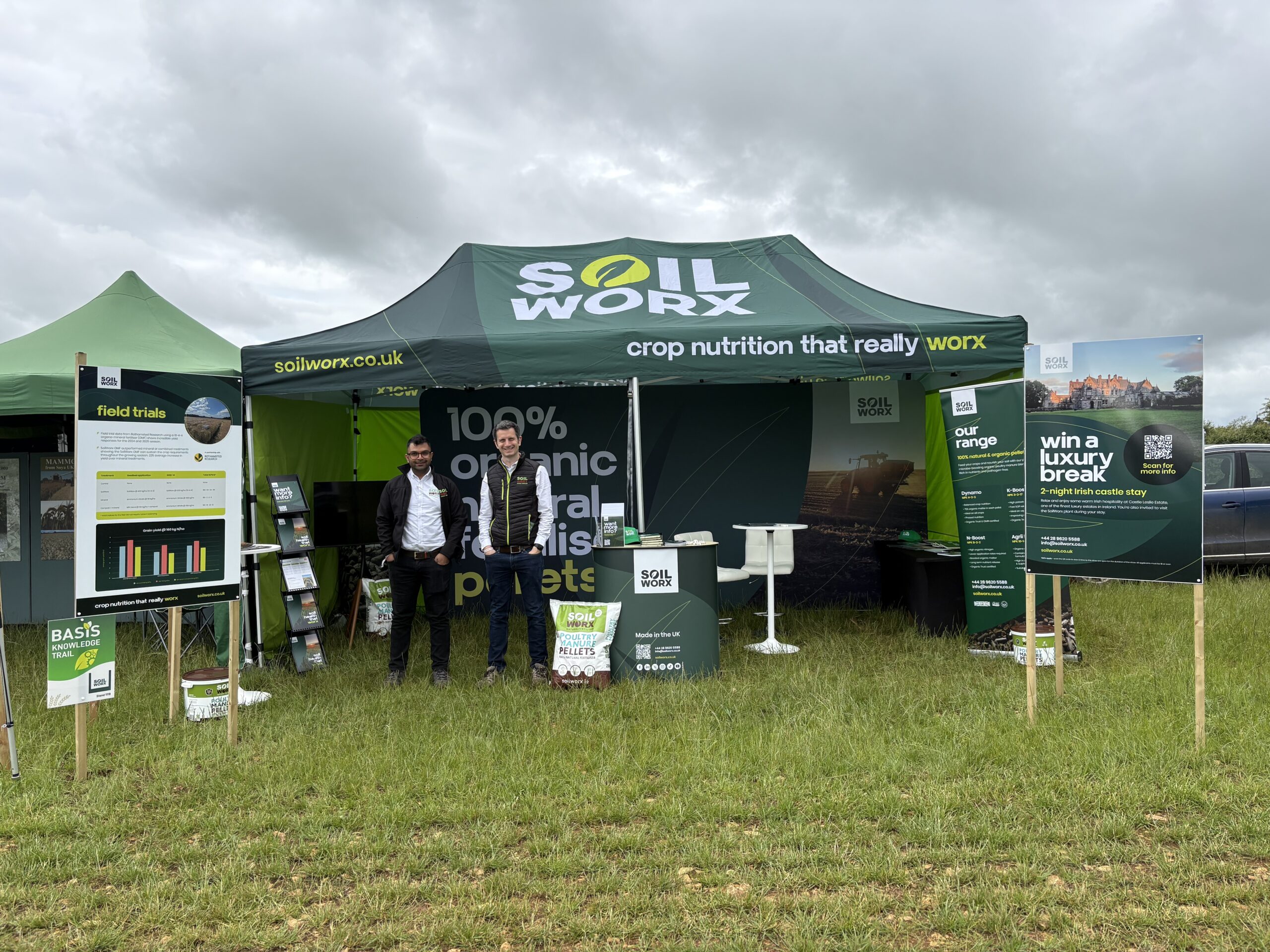
Cereals & Groundswell show growing interest in organic crop nutrition
Initial feedback from one fertiliser provider at Cereals indicates a shift in momentum for organic crop nutrition. Speaking after two days talking directly to growers, SoilWorx Sales Director Dr Paul O’Hora, described a consistent theme emerging from conversations. “More farmers are looking to do things differently,” he says. “These weren’t just organic farmers,” he explains. “These were conventional farmers that were concerned about supply, reducing their synthetic inputs and exploring alternative ways to improve their soils and yields.”
Supply concerns accelerating the shift
For many farmers the catalyst for these conversations has been uncertainty of supply – and on two fronts.
The first concern is with synthetic fertiliser. With global markets volatile and the situation in key production regions still unclear, growers are questioning whether supply will be reliable or affordable in 2027.
The second worry is farmyard manure. Growers that previously relied on ‘straw-for-muck’ arrangements are finding that source increasingly difficult to access, as livestock farmers retain organic matter for their own land rather than trading it on. “The message we heard quite consistently was ‘we just can’t get hold of it now’,” says Paul. “Farmers with muck are keeping hold.”
Thursday at Cereals, Paul noted, felt particularly business-focused: “The farmers coming to the stand had a clear agenda. They’d sought us out. They wanted to know more, or were looking at next year’s cropping programme and how organic nutrition could slot in.”
Soil health centre stage
Across conversations on the stand, soil health emerged as another recurring concern. Two farmers from Cornwall presented Paul with their soil analyses and asked for his assessment of how they could improve. “They were genuinely looking for advice and for ways to keep improving,” he recalls. “And there was almost a friendly rivalry between them about who could do better. It was a great conversation. Farmers know that they need to do better with organic matter and soil health, and are increasingly looking for partners who can help them understand the data, not just supply the product.”
Rothamsted data generating stand-out interest
SoilWorx’s Cereals & Groundswell presence was bolstered this year by the Rothamsted Research trial data for its organo-mineral pellet. This showed a 27.7% grain yield increase over mineral nitrogen at the same application rate of 160kg N/ha. Having independent, multi-site results to present on stand made a visible difference to conversations. “The data this year generated a lot of interest,” says Paul. “Especially when we started showing the yield increase on the stand.”
The SoilWorx pellet also prompted a positive response. Notably smaller and denser than many organic fertiliser products on the market, Paul reports that farmers who have previously been put off by the size of other pellets – and concerns about spreadability – were reassured by what they could see and handle on the stand. This was backed up by crushing strength and spreading data.
Drone operators among enquirers
Among the more unexpected conversations on stand were approaches from drone operators looking for fertiliser products compatible with drone application. SoilWorx has already conducted a drone trial on a winter wheat field in the South Midlands and is watching the results closely.
The potential agronomic benefits of drone application align closely with the SoilWorx message on soil health: once a crop is drilled, granular fertiliser applied by drone avoids any additional compaction passes across the field. “If you then also apply liquid sprays by drone, you could almost not touch the crop until harvest,” Paul observes. “For soil health and compaction, that would be a significant win.”
A confident mood, despite the pressures
Despite well-documented pressures on farm businesses, the team found the mood at Cereals & Groundswell broadly optimistic. Paul also noted the increasingly international character of the event, with visitors from Ireland, France and further afield stopping at the SoilWorx stand, alongside researchers from several UK universities. Younger attendees (including students and the next generation of farm managers) were among the most engaged. “Sustainable farming is high on the agenda for young people coming into the industry,” he says. “They’re clued-up on what they need to do for the future.”
Looking ahead, Paul sees the exploratory conversations at Cereals & Groundswell as the beginning of a shift that will gather pace. He draws a parallel with broader patterns of behavioural change. “In the same way that COVID accelerated people’s migration to online shopping – it was already happening, but COVID was the big rocket boost – I think supply pressures and global uncertainty are definitively accelerating a lot of people’s journey towards alternative nutrition sources.”
His advice to farmers still weighing their options is straightforward: “You don’t need to take organic nutrition across an entire field. Do a tramline, get confidence in the product, and see for yourself. We had farmers at the stand where you could see the eyes light up when they realised they could de-risk it that way. That’s where we want the conversation to start.”